munmun starts before your baby does
Find the name by birth star or rashi, let the grandparents vote on it, watch the days count down and know which ceremony is coming up, months before there is anything to log. munmun skips the kick counter and the size-of-a-mango updates, and it never sends a notification on its own.
Every birth star fixes the first syllable
Tap a nakshatra and its naming syllables appear, with names that fit. This is the app's real finder logic, not a mock-up.
- Ojasvigour, lustre
- Omthe sacred syllable
- Oviyaartist, beautiful drawing
Find the name
Naming is the first thing a family does together, and it happens months before there is a baby to log. So munmun’s birth-star name finder is open to anyone: it works in the browser, without an account or an install, before you have signed up for a single thing.
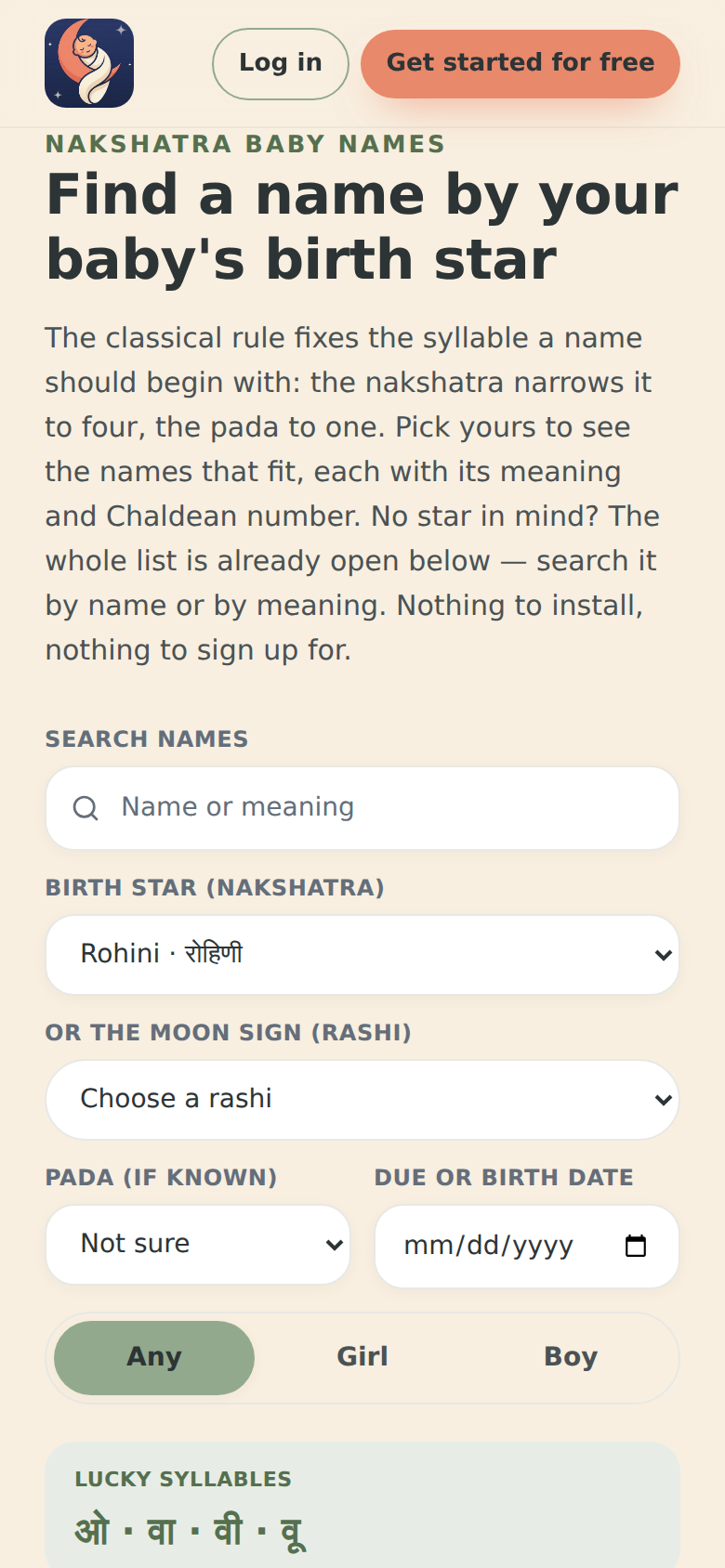
The classical rule says a baby’s name should begin with a syllable belonging to their nakshatra. The birth star fixes four, and the pada, if the family has had the chart cast, narrows it to one. Pick yours and munmun lists the names that fit, so the shortlist starts out correct instead of being checked against a chart afterwards.
A birth star is not the price of admission. The finder opens on every name it has, with a search box above the pickers: type a name, half a name, or the meaning you want it to carry, and it matches the Roman spelling, the family’s own script and the meaning alike. Every control — search, star, sign, girl or boy — only narrows that list, so a family who was never told a star still has names to read instead of an empty screen asking for details they do not have.
A chart gives you the nakshatra; relatives quote the rashi (moon sign). munmun takes either. Pick a rashi, and that sign’s nine naming syllables and every matching name appear before any birth star is known. Pick a star and pada instead, and it tells you which sign that lands in. When a star straddles two signs it says so plainly; the pada decides.
A family who hasn’t had the chart cast yet still gets a usable list; a family who has gets the precise answer at the top. Showing only one or the other would fail half of them, so the pada-exact names lead and the rest of the star’s syllables follow.
Every name carries its meaning and its Chaldean number, the system the numerology calculators a family is already consulting actually use. The birth-day number is taken as the day of the month, reduced, which is what a mulank is. It is shown as a compatibility score and nothing more, because ranking somebody’s name is not munmun’s place.
Shortlist your favourites and send a single link to the family. Grandparents tap the names they love from their own phone, with no app or account to set up. Votes are anonymous and uncapped, because this is a family ritual, not an election. Changing the shortlist clears the votes, since a different list is a new question rather than an edit to the old one.
Browsing is free; making the share link is the one thing that needs an account, because a shortlist has to belong to somebody. So the twelve names you picked before signing up are parked and restored on the other side, and you come back to your own list and the link you asked for instead of an empty form.
The months before
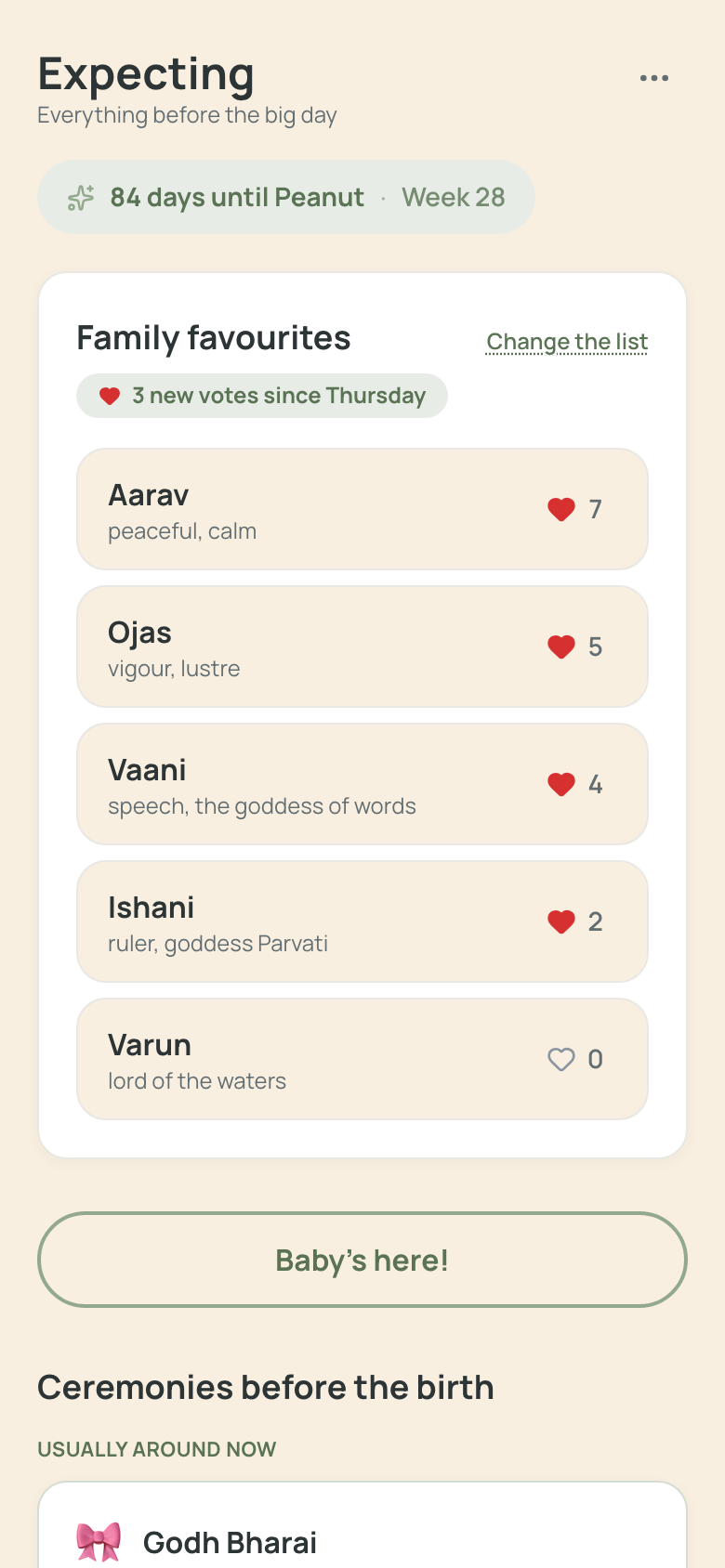
Say yes to “we’re expecting” at sign-up and munmun gives you a home for the wait: a due-date countdown, the family’s shortlist with its votes, and the ceremonies coming up. That is the whole of it. The things it deliberately leaves out matter as much as the things it has.
The bar reads “84 days until Peanut · Week 28”, and once the due date passes it reads “any day now”. There is no negative number and the word “overdue” appears nowhere in the app. A parent at 41 weeks is already being asked about it by everyone they know; munmun does not join in.
The shortlist sits above everything else on the page, because it is the only part that changes when somebody *else* acts. A countdown moves by one a day and gives nobody a reason to open the app; a grandmother voting for Aarav overnight does. So the page leads with “3 new votes since Thursday”, measured against the last time you looked, on your own device, since the votes themselves are anonymous and carry no timestamps.
munmun has no fetal-development content at all: the kick counter, the weekly size comparison, the body-changes reading, the contraction timer and the symptom log all live in apps built for them. Pregnancy tracking is a category with enormous incumbents and a genuine privacy hazard, because reproductive-health data is the most sensitive a family will ever hand an app. So munmun takes the part it can do honestly (the name, the countdown, the ceremonies) and leaves the rest alone.
Nothing is scheduled against a due date. The app will not tell you there are “only 30 days to go”, will not nudge you on the day itself, and will not follow up the week after. Roughly one in six known pregnancies ends in loss, and a cheerful notification arriving after one is the cruellest thing this feature could possibly do. The countdown is something you come and look at; it never comes and finds you.
Turning the pregnancy into a real baby is a button you press, and the only one there is. munmun never asks whether the baby has arrived. When you do press it, you fill in the same new-baby form the rest of the app uses, and munmun works the birth star out again from the actual moment of birth rather than the due-date guess, then shows which of the shortlisted names still fit it. Everything from that point on is the ordinary app.
A parent adding a second baby gets the same “is your baby here yet?” question, and a family who is both raising one and expecting one gets a single slim line on their home screen, “Peanut arrives in 84 days”, that opens the pre-birth page. It stays a signpost instead of becoming a second dashboard: the sleep card and the log buttons are what that family opened the app for.
The pre-birth page sits outside the signed-in app shell, since everything in that shell assumes a real baby — which used to leave an expecting family with no bottom nav, no side rail and so no way off the account on their own phone. Sign out now sits in the same overflow menu, and it is the app’s own: queued offline writes are flushed first, anything still unsynced is warned about, the offline cache is wiped so the next person on a shared device sees nothing, and the push and widget tokens are revoked before the session goes. A phone you cannot sign out of is a phone you cannot hand to anybody.
Removing a pregnancy is a plain Remove in an overflow menu. munmun skips the confirmation dialog, the reason picker and the condolences, deletes the row outright, and keeps no record that the due date was ever there. The person tapping it may be having the worst week of their life, and “are you sure?” would make them say it twice. The only friction is the extra tap it takes to open the menu, so a thumb can’t reach it by accident.
The ceremonies before the birth
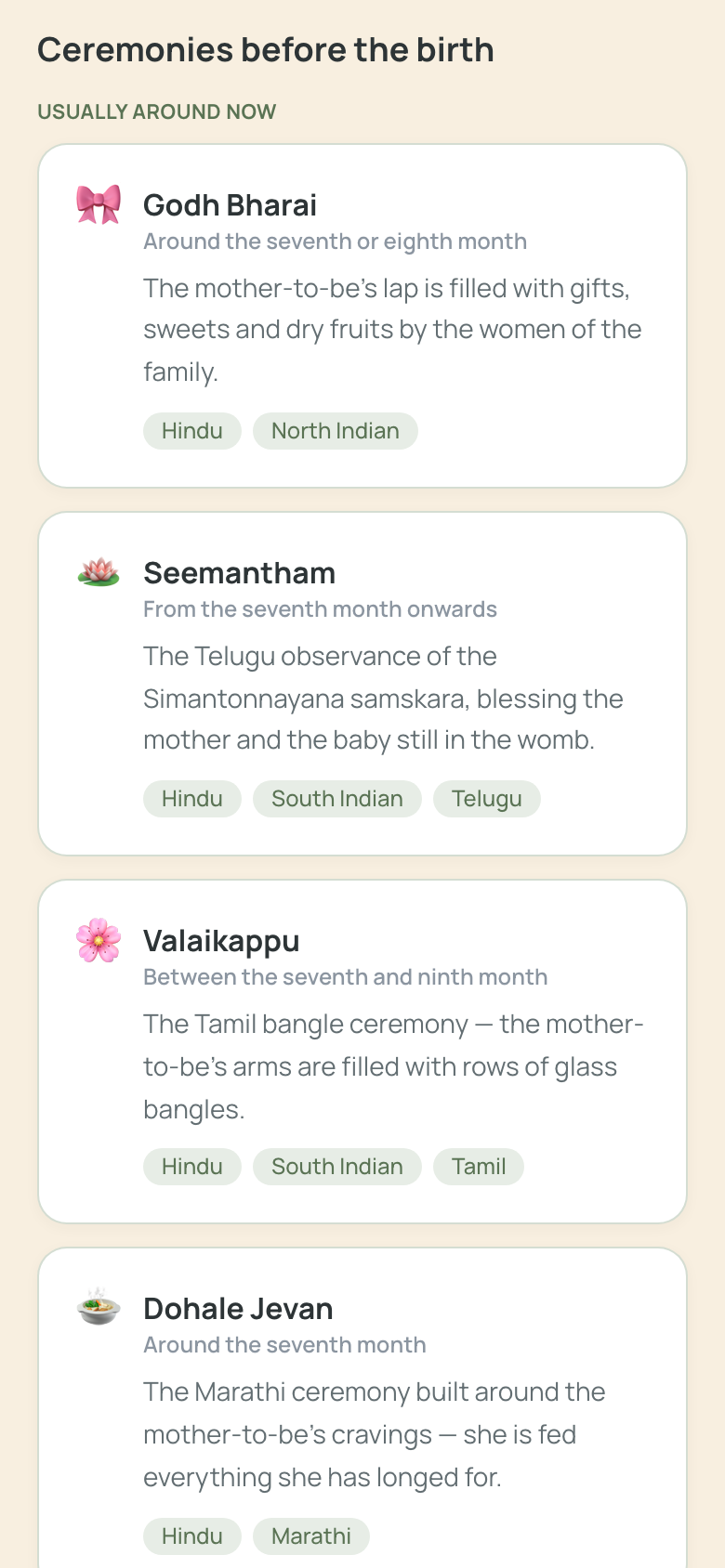
Godh Bharai, Seemantham, Valaikappu, Dohale Jevan and the American baby shower: the rites of the last trimester, keyed to the week you are in, each explained in the words a family would use instead of an encyclopaedia’s.
Every ceremony is listed for everybody. A pregnancy carries no region (there is no baby yet to hang one on), and asking a family “which tradition are you?” just to shorten a list of five is both intrusive and wrong for the mixed households this app is full of. A Tamil-Marathi couple should see Valaikappu and Dohale Jevan together, without being made to choose.
Only the order is personal. Whichever rites have a window around your current week lead under “Usually around now”; anything else follows under “Other traditions families mark”. Godh Bharai and Dohale Jevan sit around the seventh month, Seemantham, Valaikappu and the baby shower run on through the third trimester, so what is imminent rises to the top while the full list stays put.
Each rite wears its labels (Telugu, Tamil, Marathi, North Indian, American) and the names render in the family’s own language and script. Nobody has to read five descriptions to work out which one is theirs; the one they grew up with is recognisable in a second.
These five sit in their own gestational category, keyed to weeks of pregnancy instead of months of age. They appear on the pre-birth page and nowhere else, so a baby’s ceremony timeline, which runs from the naming to the first haircut, never fills up with rites that happened before they were born.