
The health record your family actually keeps
The vaccine schedule you're really on (IAP or Govt UIP in India, CDC/AAP in the US), the symptoms and medicines of an ordinary rough week, and a one-tap summary that walks into the pediatrician's office prepared. munmun helps you notice patterns and get ready for visits; it never hands you a diagnosis.
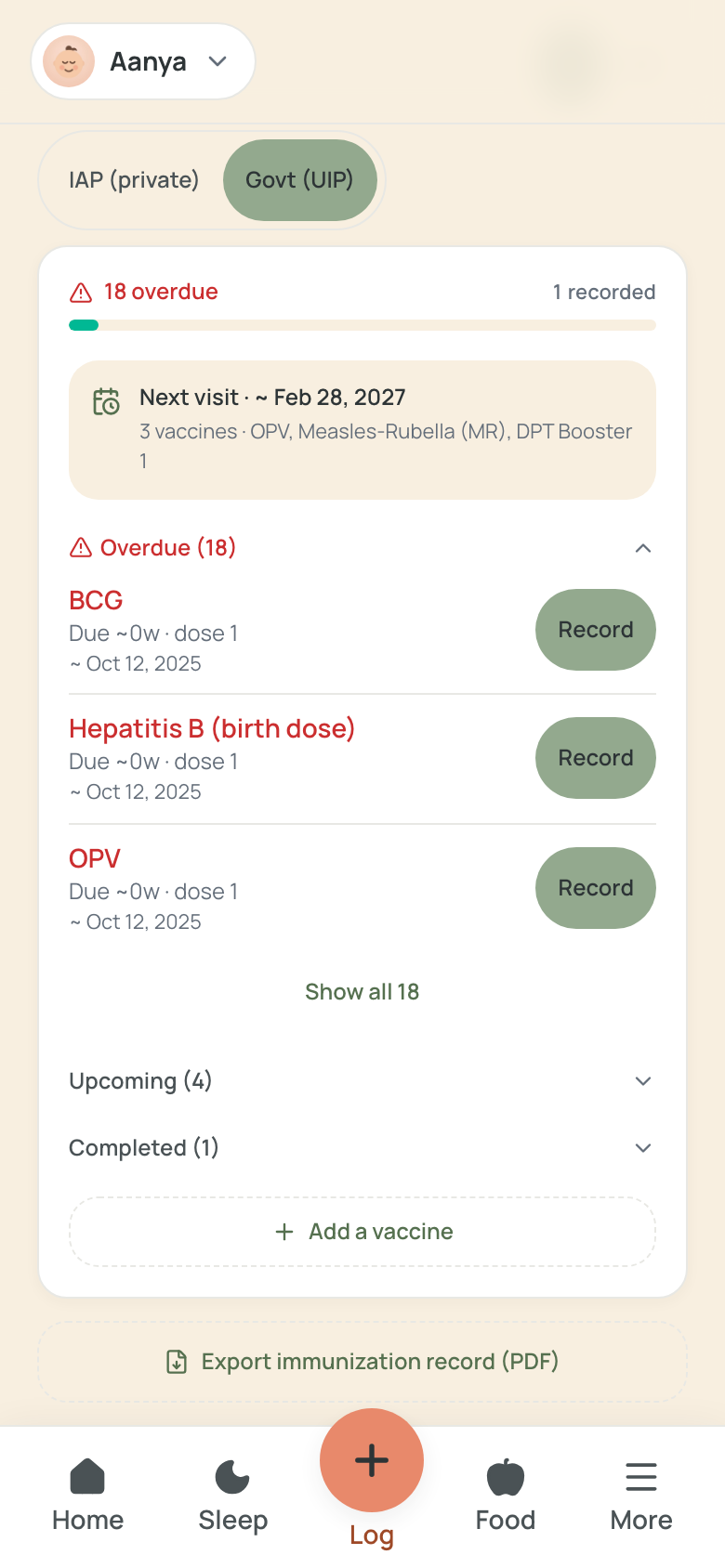
The vaccine schedule
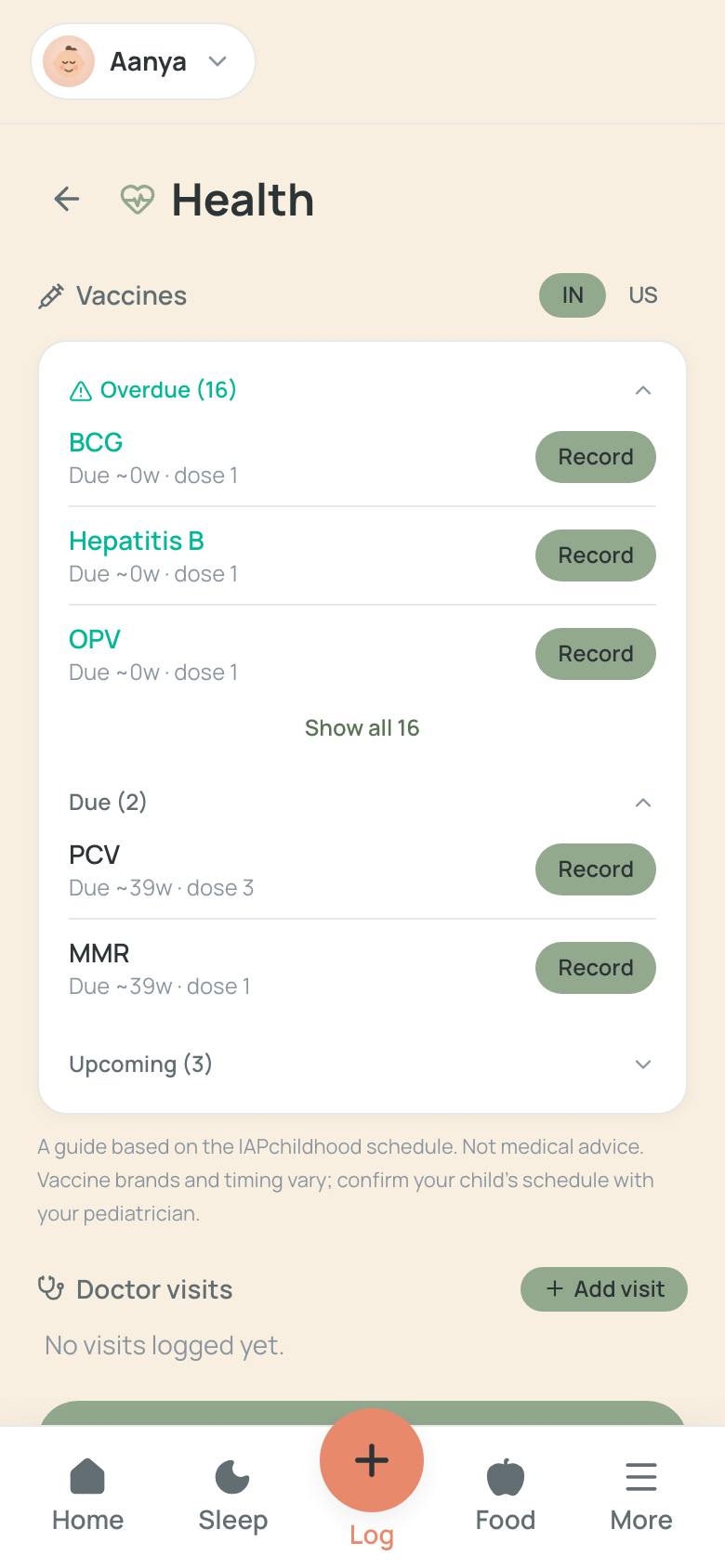
India runs two vaccine schedules at once: the IAP series private pediatricians work from, and the government UIP list immunization centres follow. They are genuinely different documents, so munmun tracks whichever one your family is really on — and US families get CDC/AAP with no picker at all.
A UIP family tracked against the IAP list sees paid vaccines they were never offered, marked overdue — which reads either as an error or as an upsell, exactly the anxiety a tracker should remove. So the India schedule carries an IAP (private) / Govt (UIP) pill that switches the whole tracker. Switching is non-destructive: recorded doses stay recorded, shared vaccines carry across as done, and an MMR never silently counts as the government’s MR, because they aren’t the same product.
The IAP schedule includes the paid vaccines a government card never mentions and every private pediatrician recommends: influenza at 6 and 7 months, typhoid conjugate at 9 months, Hepatitis A at 12 and 18 months, varicella at 15 and 18 months, alongside the BCG-to-MMR backbone. Each gets the same projected date, next-visit bundling and record/undo flow as the rest.
One line sits atop the schedule and answers the only question that keeps a parent up. When something needs you it names the action — "1 overdue · 2 due" — and when the last due dose is recorded it flips to a calm green "All caught up." The progress bar measures the doses due so far, not the whole 18-year schedule, so a newborn never reads "2 of 25."
A dose "due ~39w" leaves you doing the arithmetic. munmun projects your baby’s birth date forward and prints the concrete day underneath — "~ Aug 20, 2026" — so upcoming shots become something you can book around, and an overdue one shows when it was meant to happen.
Real schedules bundle several vaccines onto the same age: the 6-week visit alone is five shots. A single line reads the next round as an appointment — "Next visit · ~ Aug 20: 5 vaccines · Pentavalent, OPV, Rotavirus +2 more" — so you book one trip to the clinic instead of decoding a wall of rows.
One push per round (five needles is one appointment), about a week before it comes due, and it fires once per round, ever: a gentle catch-up for a few days if the date slips, then it trusts you. Off until you turn it on, like every munmun reminder, and quiet hours are honored.
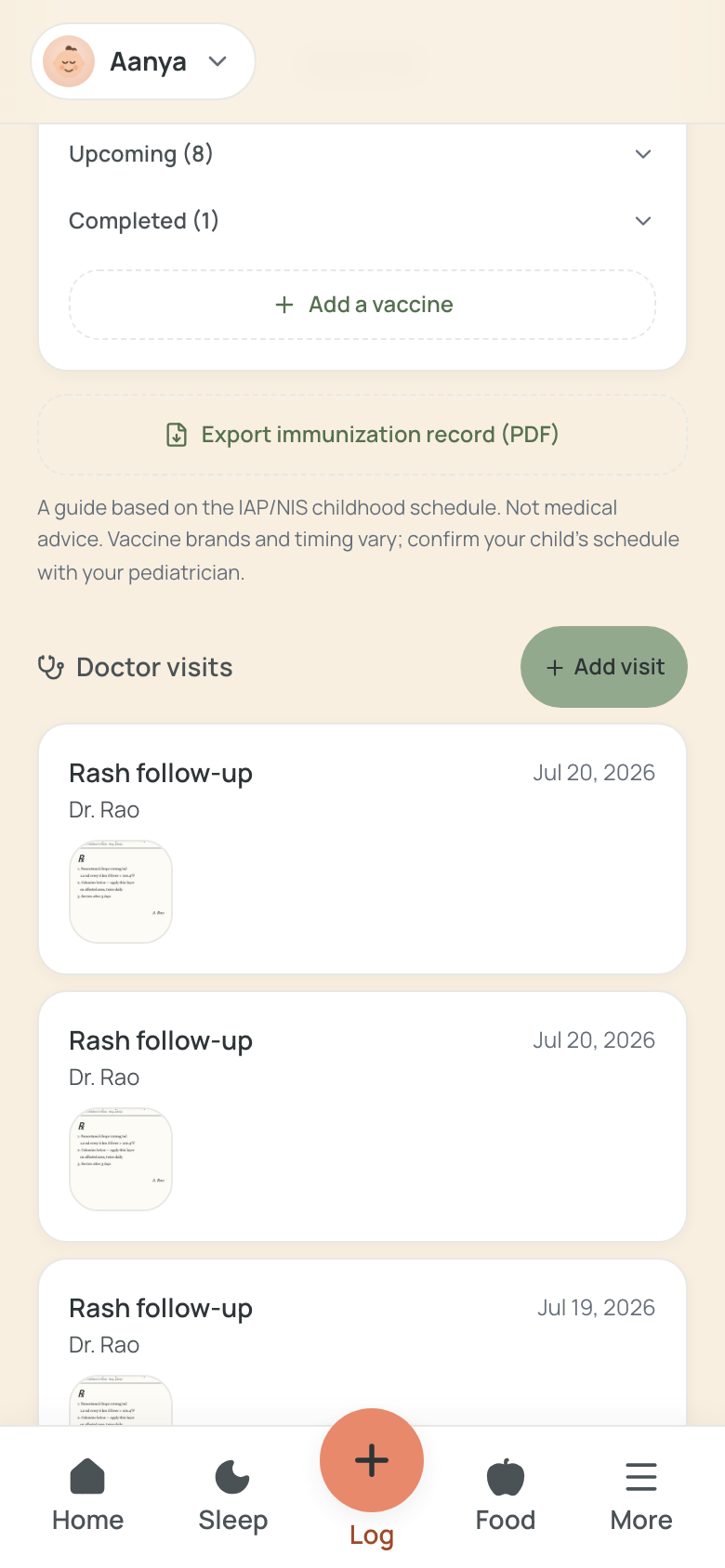
A record you can hand over
A school admission, a day-care, a new pediatrician after a move: all of them ask for the same document, and until now the only copy was the dog-eared card in a drawer.
One tap exports a clean record: the baby’s name and date of birth, which schedule they’re tracked against, doses given in the order they were given the way a clinic card reads, then what’s still due with real dates. It goes out through the ordinary share sheet, and a line at the foot says plainly that it’s the family’s own record, not an official certificate — a document that looked official but wasn’t would be worse than none.
A yearly flu shot, a typhoid booster, a vaccine under a local brand name: tap "Add a vaccine," give it a name and the dates the doctor gave you (or none), and it sorts into the same Overdue / Due / Upcoming / Completed groups as the standard schedule. Custom doses carry the actual date your doctor said, not an age week — and they ride along in the exported record, because the one audience that asks for it needs the full list.
Once a shot is logged it moves to Completed carrying the day it was administered, written the way the rest of the schedule speaks: "dose 1 · given May 14, 2026" — that’s when it happened, not when it was due, and backdating is welcome.
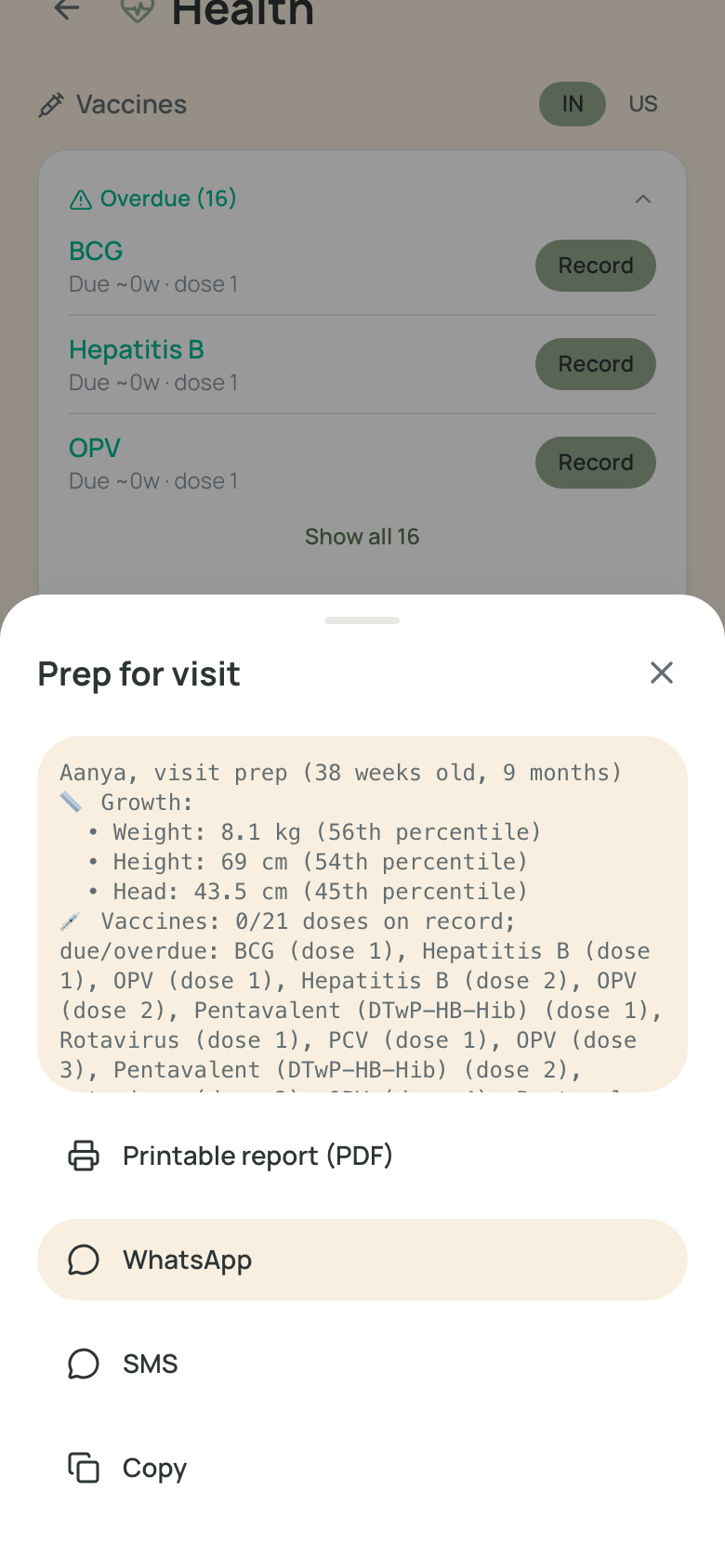
Ready for the pediatrician in one tap
Heading into a checkup, tap "Prep for visit" and munmun composes the summary you’d otherwise scramble to remember in the waiting room — shareable via WhatsApp, SMS or a printed report.
Latest growth, recent fevers and symptoms, vaccines due, recent milestones — plus the daily rhythm as per-day figures: "~8 milk feeds/day (breast), ~2 solid meals/day", "~6 wet diapers a day", "~14.5h sleep, ~5h longest stretch." Intake, output and rest: the three questions on every infant intake form, answered from what you already logged.
"What have you been giving her, and how often?" used to mean scrolling the raw log mid-appointment. Now the last 14 days roll up per medicine — "Acetaminophen 5 mL ×3 (last yesterday)" — with a nanny’s "tylenol" and a parent’s "Tylenol" counted as one.
A 39° spike that broke by bedtime reads very differently to a doctor than a 38.5° fever dragging on. The summary counts the distinct days a fever-level reading showed up — "Highest temp (14d): 38.9°C over 3 days" — and only mentions duration when it’s actually part of the story.
Each growth line carries the change since the last measurement — "6.2 kg (50th percentile), +0.4 kg in 3w" — and when a reading has crossed two or more major WHO centile bands, the same follow-up rule pediatricians use, it says so plainly: "dropped from 75th." A factual flag the doctor can weigh, never a verdict.
"Come back in two weeks" used to live on one old visit card. The soonest still-pending follow-up now sits as a banner atop the Health page, counting down as it approaches, and clears itself the moment you log the return visit — no manual check-off, no nagging about a checkup you already went to.
Every visit takes up to four photos — the prescription, the clinic slip, the growth-chart printout — and the visit report carries a Photos section with recent symptom shots plus the last prescriptions, so the doctor sees the rash from Tuesday and what was prescribed for it on one page.
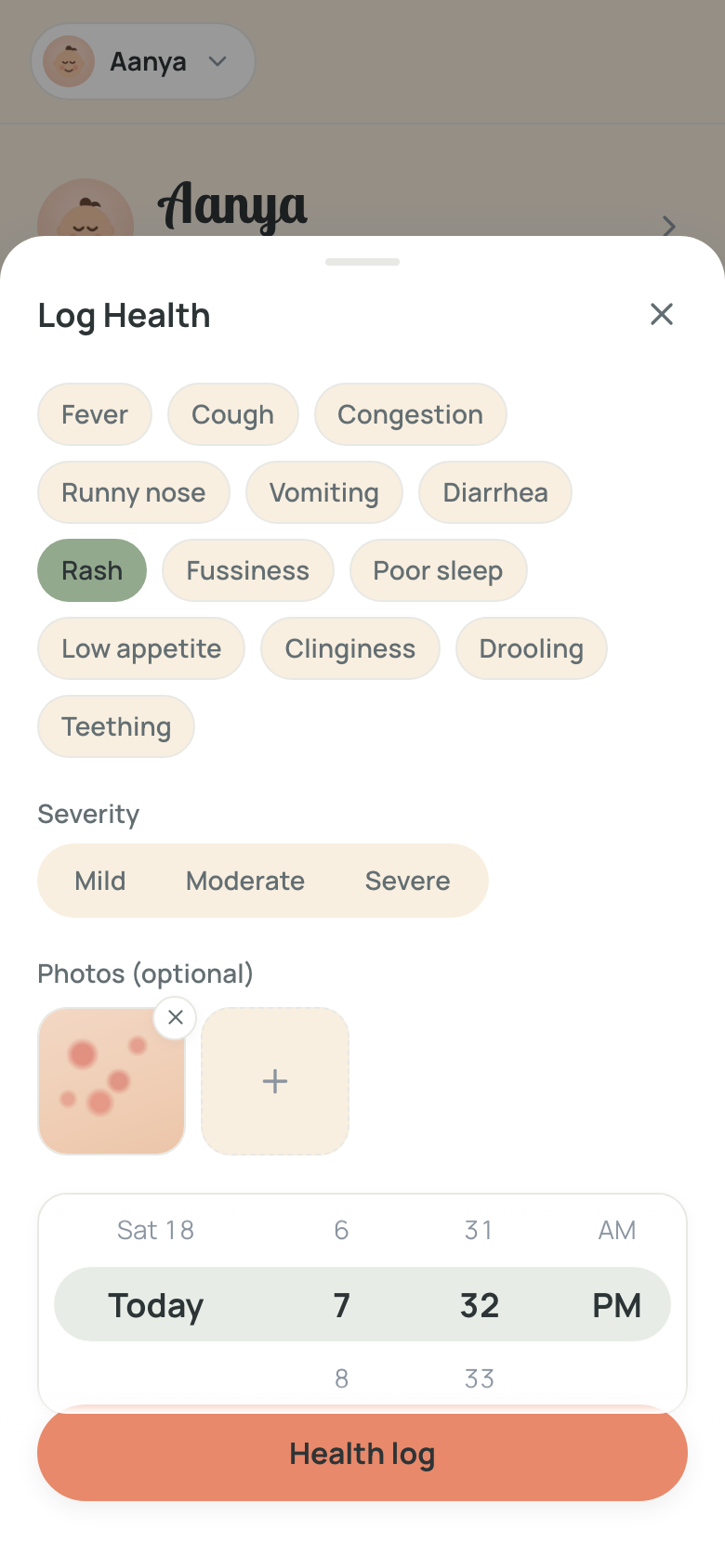
The days in between
Symptoms, temperatures and medicines are logged in seconds from the same place as everything else — with the small intelligences that stop 3 a.m. mistakes.
Fever, cough, congestion, rash, fussiness, poor sleep, low appetite, drooling and more — structured enough to spot patterns, quick enough to tap, with a free note when the list doesn’t cover it. A health log takes up to four photos: by the appointment the rash may have faded; the photo hasn’t.
Illnesses cluster: a cold gets logged day after day with the same symptom set. A fresh log offers a single "Same as last time: Cough, Runny nose" chip that fills the set in one tap. Deliberately opt-in — it never pre-selects, and temperature always starts blank, a fresh reading each time.
Temperature is thumbed in one-handed in the dark, so a slipped decimal ("986") or the wrong °C/°F toggle slips through easily. An implausible reading draws a calm one-line caution — "That looks like the other unit. Check the °C/°F toggle." — a soft nudge, never a block.
Track a daily vitamin, an as-needed med like Tylenol, or a fixed antibiotic course munmun walks "day 5 of 10" and flips to "Course complete" so you know to stop. A "Same dose: 2.5 mL" chip recalls the last dose per medicine, and an opt-in nudge times the next dose from the last one you actually gave — it helps you finish a course, never nags you to start one.
The cross-caretaker guard flags a fever reducer given too soon after the last dose — the parent-and-nanny double-up — and it also counts the rolling 24 hours, so four correctly-spaced doses that reach the usual daily ceiling raise a plain flag too. The ibuprofen age caution reads your baby’s actual age, escalating for a three-month-old and disappearing entirely past six months. Prompts to check with your pediatrician, never dosing instructions.
What munmun notices
Proactive observations that connect what you logged — framed as things worth mentioning, and never as a diagnosis. Everything here sits behind a clear "munmun helps you notice patterns and prepare for visits. It is not medical advice" line.
Flags an elevated temperature and whether it’s trending up or easing. The closing line reads the baby’s age: for a young infant any fever nudges toward a same-day call, while a moderate fever in an older baby keeps a calm "worth mentioning if it persists." A fever spanning three or more days is escalated on its own, even when each reading is only moderate.
One loose diaper or one sniffle draws no note at all. The watches speak when a pattern forms: vomiting and diarrhea showing up together (the pairing that dries a baby out fastest), cold signs recurring through the week, or a rash that keeps coming back — and a rash alongside a fever is escalated at any age, with the classic press-test check.
When the latest measurement has dropped two or more major WHO centile bands since the previous one, a supportive note joins the panel. Only downward crossings surface — a climb is usually reassuring catch-up growth — and ordinary within-band wobble goes unmentioned.
When fussiness, broken sleep and low appetite cluster during a stormy leap week, munmun connects them: "This rough patch lines up with the stormy stretch of Leap 6." No other tracker knows both the symptoms and the leap.
Symptoms that appear within a day or two of a recorded shot get a note that mild reactions are common — and clusters of drooling and fussiness in the typical teething window get a gentle teething nudge, so an ordinary rough day doesn’t read as a mystery.