
Everything munmun knows about feeding your baby
Every Indian first food, from ragi and moong dal to egg yolk and fish, in your language, with the nutrition and safety answers you'd otherwise be Googling at 2 a.m.
Fill the rainbow, one food group at a time
munmun scores each week’s variety across six food groups. There is no streak to break; you just fill the gaps over a rolling seven days. Tap a group to watch it light up.
Tap a food group to start filling the week’s rainbow
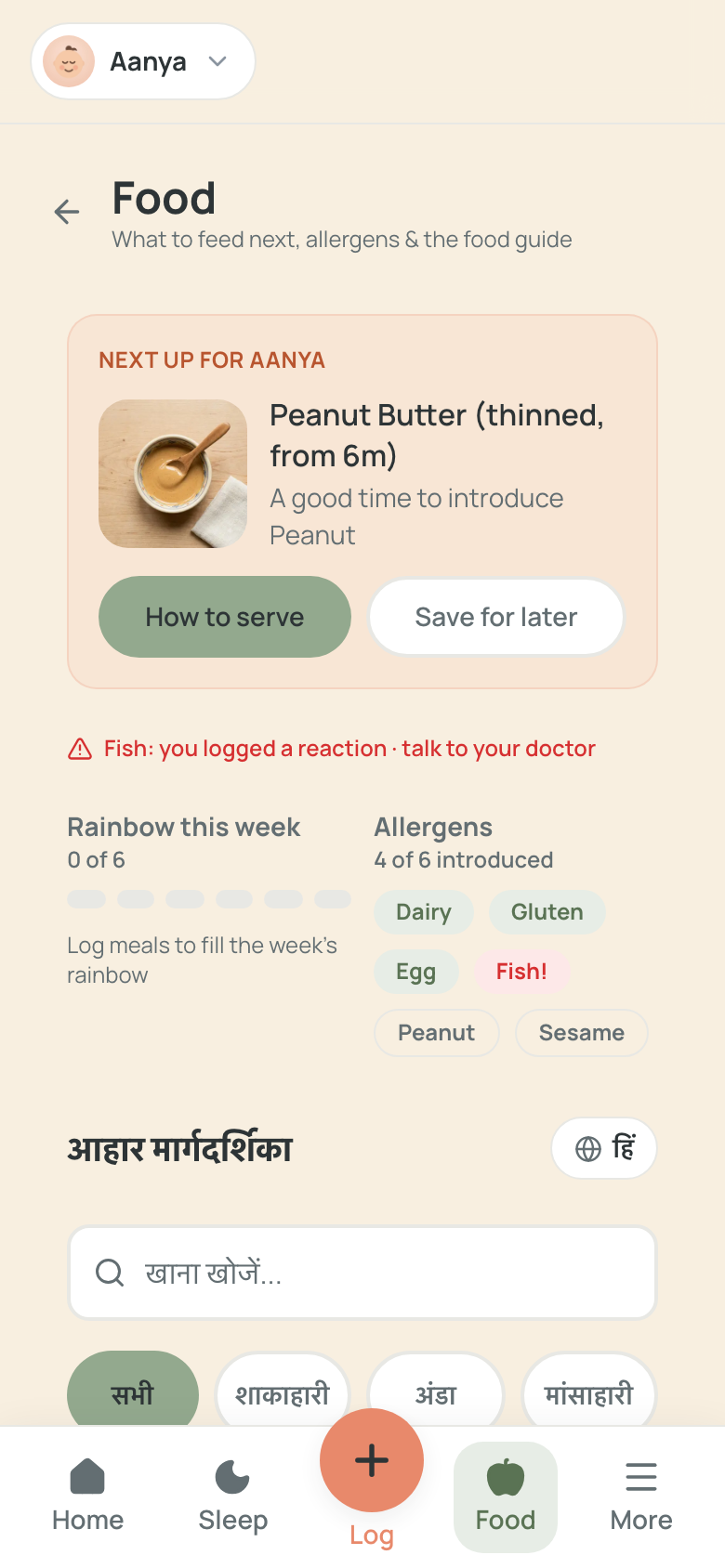
The catalog
170+ Indian baby-led-weaning foods, browsable as swipeable shelves in five languages, each with the familiar veg, egg or non-veg marker and prep tips. Most everyday fruits and vegetables are in there, so you can log almost any produce from the daily log without a special recipe.
170+ foods in five languages with baby-led weaning prep tips, browsed as swipeable shelves. The shelves now cover most common fruits and vegetables, so almost any produce is one tap to log.
Food names in English, Hindi, Telugu, Tamil & Marathi, and search works across every one of them. The app itself reads in eight languages.
Dosa doesn't vanish when your baby turns ten months. Each stage tab shows everything unlocked so far. The stage's new foods lead every shelf, and earlier familiars follow with a small badge showing when they joined the menu.
The month-by-month chart Indian parents actually search for: every stage from 6–8 to 18–24 months on one screen, foods grouped the way a meal is built (grains, dals, vegetables…), iron-rich foods starred, your baby's current stage highlighted. A "Share this stage" button composes the WhatsApp message families forward to each other.
Every food carries the familiar veg, egg or non-veg marker. A funnel button by the search bar opens a "Filter foods" sheet where vegetarian families hide non-veg while others jump straight to chicken, fish & eggs; the pick shows as a removable chip under the search bar and is remembered for next time.
On the browse-all view each stage promotes its egg, chicken & fish foods in a spotlight row above the shelves, so iron-rich animal proteins are easy to find. Vegetarian families never see the row.
Pick a region (South, North, East, West, Northeast, Pan-India) in the search bar's filter sheet and every shelf & spotlight narrows to that zone; the pick shows as a removable chip, is remembered across visits, and each food shows a small region label. Untagged staples stay under All and Pan-India, so nothing disappears when you filter — and searching by name still surfaces those Pan-India basics whatever zone you're in. It also adds a "Homemade mixes" category: Uggu-style porridge powders of grains, dals & nuts soaked, dried, roasted & ground into a keep-on-hand mix, the way many Indian babies actually begin solids.
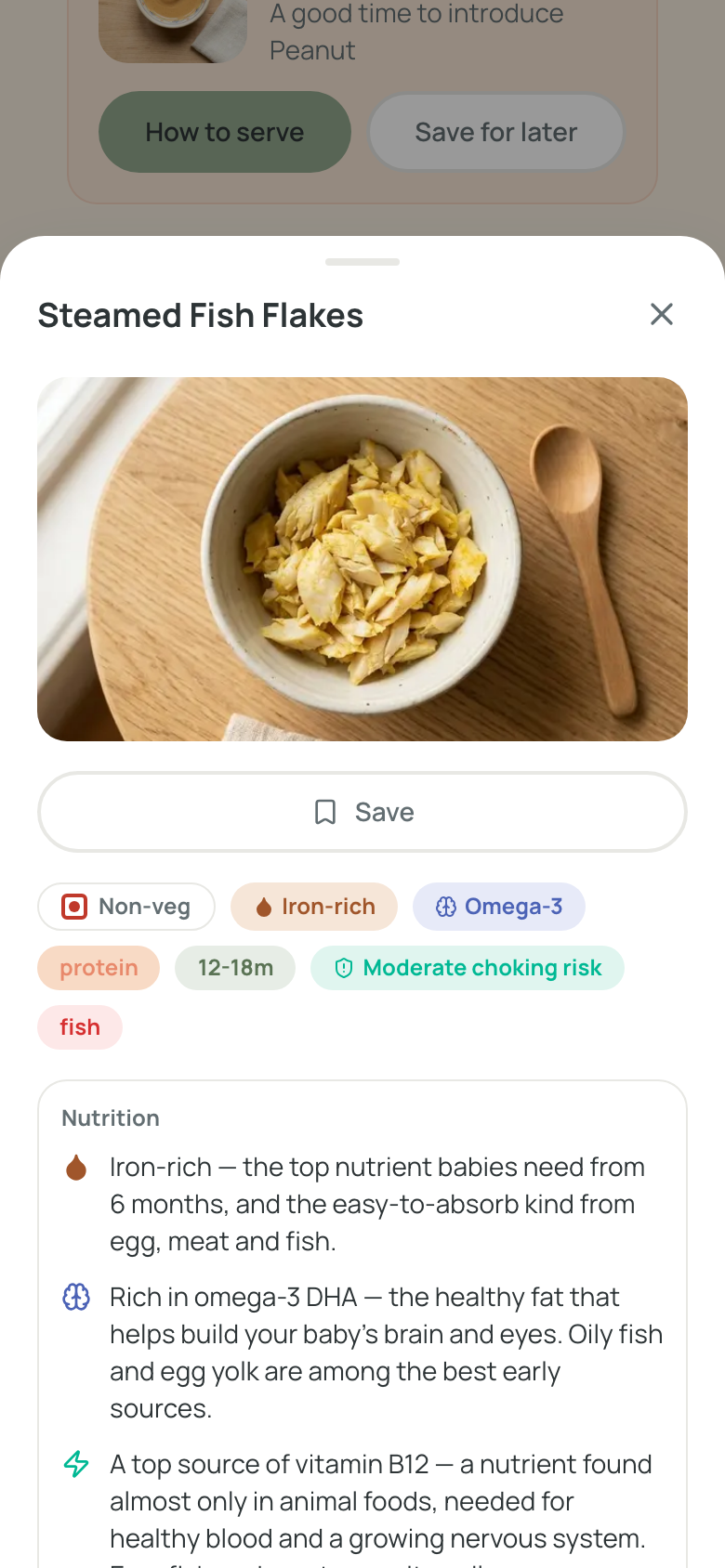
Nutrition intelligence
munmun flags the nutrients babies need most and turns them into action: iron, omega-3, B12, and vitamin-C pairings that help the iron absorb, both ways.
Iron is the nutrient babies most need from 6 months. munmun flags iron-rich foods: egg, meat & fish for easy-to-absorb iron, plus millets, dals & greens to pair with a little vitamin C.
Flagging iron-rich foods is the "early" half; the "often" half is making sure iron keeps landing on the plate. If a baby on solids has logged meals this week but not one iron-rich food, a quiet rust line nudges you to offer a dal, ragi, egg or meat, since from six months a baby needs iron regularly as milk stores run low. It stays silent the moment any iron-rich food is logged.
Plant iron (dals, millets, greens) is poorly absorbed on its own, but a little vitamin C in the same meal changes that. So when a week of meals carries plant iron and no vitamin-C food, a quiet citrus line nudges you to add a bit of guava, orange or tomato alongside. The "make the iron count" advice each food gives now watches the weekly rhythm too. It stays silent once any vitamin-C food is logged, and egg or meat iron, already well absorbed, never sets it off.
Omega-3 DHA builds a baby's brain and eyes, and its best early sources, oily fish and egg yolk, are the easiest to forget to offer. So the same weekly meal window watches for them too: for a family that eats egg or fish, a week of meals without a single omega-3 food surfaces a quiet nudge to aim for fish about twice a week or offer egg yolk. It's diet-aware, so a vegetarian household, with nothing to act on, is spared it entirely, and it steps aside on a zero-iron week so the iron nudge speaks alone.
Oily fish and egg yolk get an indigo Omega-3 chip and a note explaining that DHA, the fat that builds a baby's brain and eyes, is one more concrete reason to put fish and egg on the plate.
Each food's guidance now reads as two clear blocks. Nutrition covers iron, omega-3 and how often to offer it (egg most days, fish about twice a week, meat a few times a week); Serve it safely gathers the allergen and cook-through notes in one place.
Egg, fish and meat get a note that vitamin B12, needed for healthy blood and a growing nervous system, is found almost only in animal foods. Early non-veg meals fill a gap plants can't.
New to non-veg? At 6–8 months the guide leads with well-cooked egg yolk, the gentlest first animal food, then shows fish and soft chicken joining a stage later, so you know which one to try first.
Guava, orange, tomato and other vitamin-C foods get a citrus badge and a note: serve one alongside dal, greens or grains and your baby absorbs far more of that meal’s iron. It’s the veg-side answer to the non-veg “meat factor”.
Open any iron-rich plant food (a dal, ragi or rajma) and the “pair with vitamin C” advice becomes a row of tappable foods: papaya, mango, guava, only the ones your baby’s stage can eat. Tap one to jump straight to it.
Open a vitamin-C food like guava and the same helper runs in reverse: “Serve it with an iron-rich food” lists tappable dals, millets and khichdis your baby’s stage can eat. Whichever food you start from, the iron-absorbing pair is one tap away.
Is your baby ready to begin?
The one question every guide dodges. Around six months most babies are ready when these four signs show up together, whatever the calendar says. Tap the ones you’re already seeing.
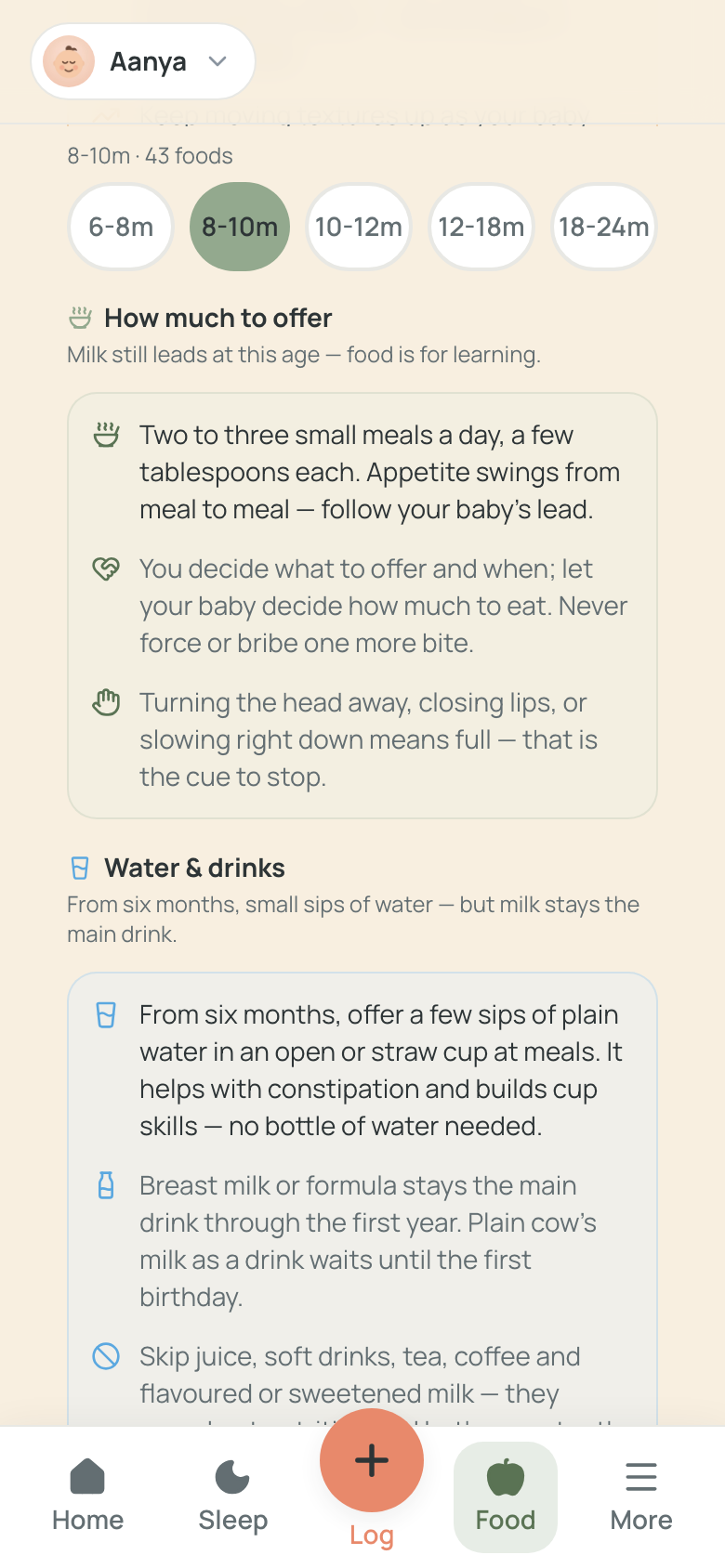
Feeding basics
The questions every new parent actually asks, answered stage by stage: is my baby ready, how much, what texture, what to drink, can they have our masala.
The guide answers the worry every new parent has: how much? A stage-aware card gives realistic amounts (milk still leads at 6–8m; a quarter of an adult plate by toddlerhood) on two feeding rules that never change: you decide what and when, your baby decides how much, and you stop on their fullness cues.
Before the very first spoonful, the guide answers the first question of all: is your baby ready? A checklist of the signs to look for together: sits with support and steady head, interested in food, tongue-thrust fading, brings things to the mouth. The signs, together, say more about readiness than the calendar does. It shows at the 6–8m stage and steps aside once solids are underway.
Parents worry just as much about how the food should look as about what to offer. A stage-aware card walks the texture climb from smooth purées to soft lumps to chopped family food as your baby learns to chew, with one rule that holds throughout: keep moving textures up, because staying on smooth purées too long can make lumps harder to accept later.
The food is sorted. But what goes in the cup? A stage-aware card answers the drink questions parents actually ask: a few sips of plain water from an open or straw cup from six months, breast milk or formula as the main drink through the first year (plain cow’s milk waits for the first birthday), and the drinks to skip entirely: juice, soft drinks, tea and sweetened milk, which crowd out nutrition and coat new teeth in sugar.
The first question an Indian family asks about baby food, and the one most guides dodge. A turmeric-gold card answers plainly: mild everyday spices (turmeric, cumin, coriander, a little hing or cinnamon) are welcome from the very first tastes, so cook baby's food in your usual tempering and they learn to love home food; a little ghee is good for a small tummy; only added salt and chilli heat need holding back. Babies don't need a separate bland pot.
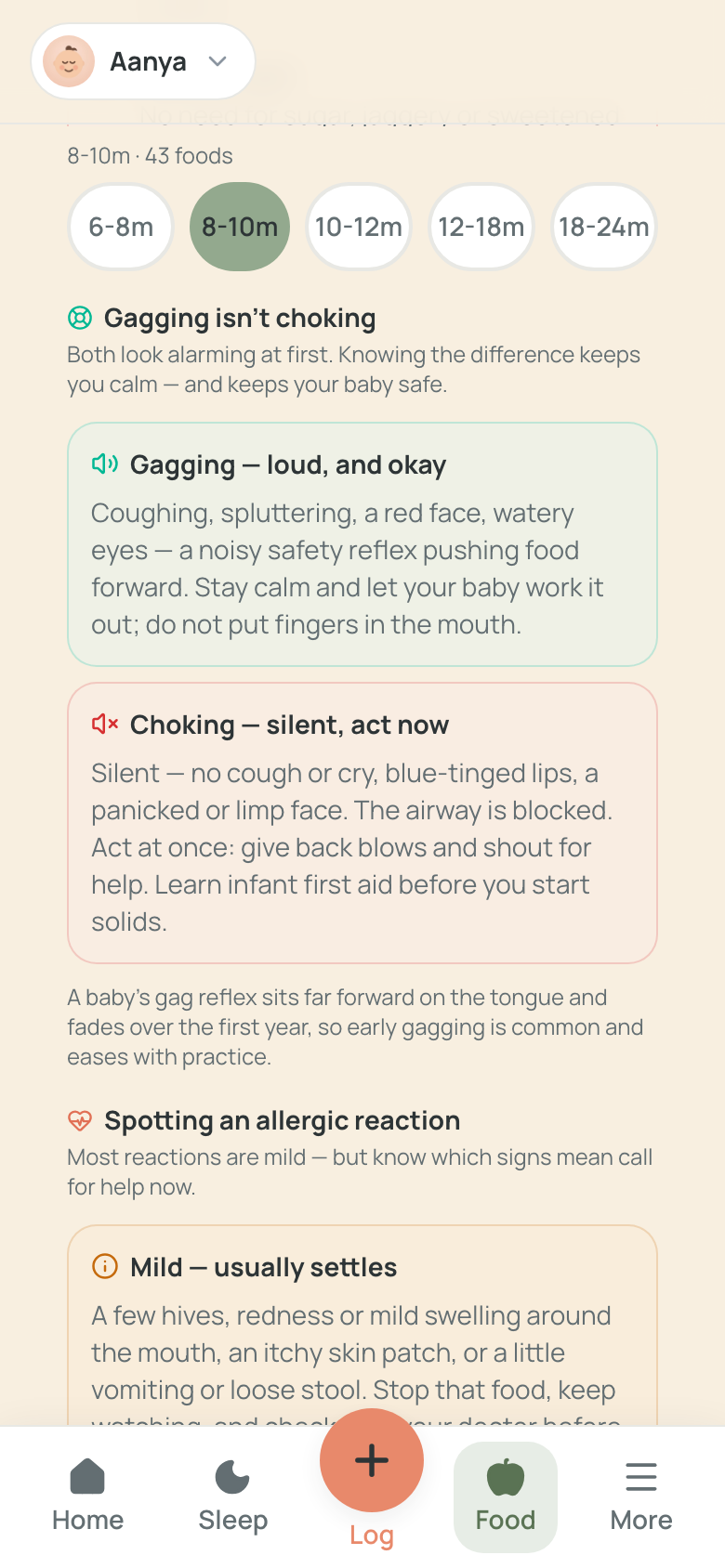
Mealtime safety
The worries that keep parents up at night, in calm plain language: choking versus gagging, cooking meat and egg through, foods to avoid, and spotting a reaction.
Open any food with a common allergen (egg, fish, dairy, peanut) and munmun spells out the current advice: start allergens early, one new one at a time in a small amount, then wait 2–3 days and watch for a reaction.
That 2–3 day watch is now visible. Once an allergen is introduced, its chip warms to amber and wears a small ring that fills across the 48 hours, so a glance tells you how much of the watch is behind you. When it closes, an all-clear check draws itself and stays for another day — and if a reaction was logged, the chip never claims all-clear.
The advice on allergens is to keep each one in the diet regularly after it lands, so tolerance holds. If a cleanly-introduced allergen hasn’t been eaten in 2+ weeks, a quiet line nudges you to offer it again. It skips any food that reacted, and stays quiet while you’re already serving one on a normal weekly rhythm.
Every non-veg food carries a plain reminder that egg, meat and fish must be fully cooked for a baby: yolks set firm, fish and chicken cooked past any pink, so undercooked animal protein never reaches a small tummy.
The guide also names what to avoid in the first year: honey (an infant-botulism risk until 12 months), whole choking-hazard foods, added salt and added sugar, each with a plain reason and a safer swap. It’s stage-aware, so honey drops off once your baby turns one.
Starting solids, no worry is bigger than choking, and the single most useful thing a parent can learn is how to tell ordinary gagging from real choking. A two-tone card makes it stick: loud is okay (a noisy safety reflex pushing food forward; stay calm), silent means act now (a blocked airway; back blows, shout for help). It closes on why early gagging is common and fades over the first year.
Every guide says introduce allergens and "watch for a reaction", then stops short of saying what a reaction looks like or what to do. This card does. A two-tone split makes the one distinction that matters: mild signs that usually settle (a few hives, mild swelling around the mouth, a little vomiting; stop the food, keep watching, ask your doctor) versus serious signs that mean call for help now (swollen lips or tongue, trouble breathing, going pale; dial your emergency number straight away). Reassurance up front: most reactions are mild, and they show within minutes to a couple of hours.
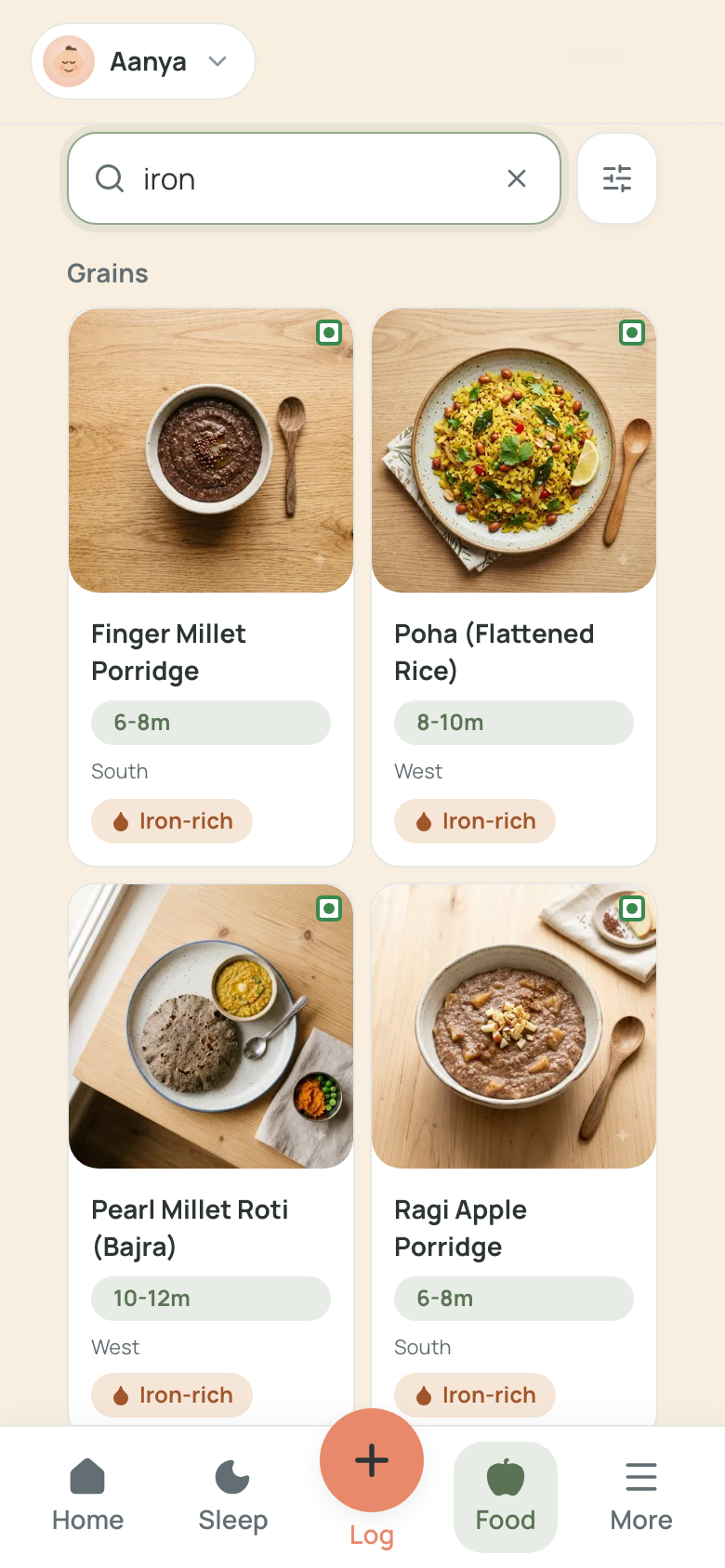
Smart search
A search that understands the words parents actually type: nutrients, allergens, diets and worries as well as dish names. When nothing matches, it offers examples of what to try.
Type “meat”, “non veg” or “protein” (words no food name contains) and the guide still finds the chicken, fish and egg. A category search like “grain” or “fruit” brings up the whole group.
The food guide grew a deep bench: texture, portions, drinks, spices, foods to avoid, gagging vs choking, spotting a reaction. Rather than a wall of cards under every stage, they fold into two labelled, tappable sections, Feeding basics and Mealtime safety. The page stays scannable so foods lead, and the guidance is one tap away with your open/closed choice remembered for next time.
Type a worry as easily as a dish. Search “honey”, “choking”, “water” or “spice” and the food guide surfaces the card that answers it: the honey-botulism warning, gagging vs choking, when water starts, how much masala. “Honey” is no food, and it used to dead-end on “No foods found”. Now the words a parent reaches for lead straight to the guidance.
Worried about iron? Type “iron”, or “omega”, “dha”, “vitamin c”, and the guide surfaces every food it flags for that nutrient, each carrying its badge. No dish is named after a nutrient, yet the word a parent worries about brings up the foods that answer it.
Managing a dairy or gluten allergy? Type “gluten”, “dairy”, “groundnut” or “til” and the guide surfaces every food that carries it, each with its allergen chip, even though there’s no gluten category and dairy hides inside dishes like paratha, pongal and curd rice. One search shows a family exactly what to watch on the plate.
The food-guide search quietly learned to match nutrients, allergens, diet and safety topics, but nothing told you those words work. Now when a search comes up empty, it offers a few tappable examples (iron, meat, honey, gluten, water), each opening a different corner of the guide, so a dead end becomes a nudge instead of a wall.
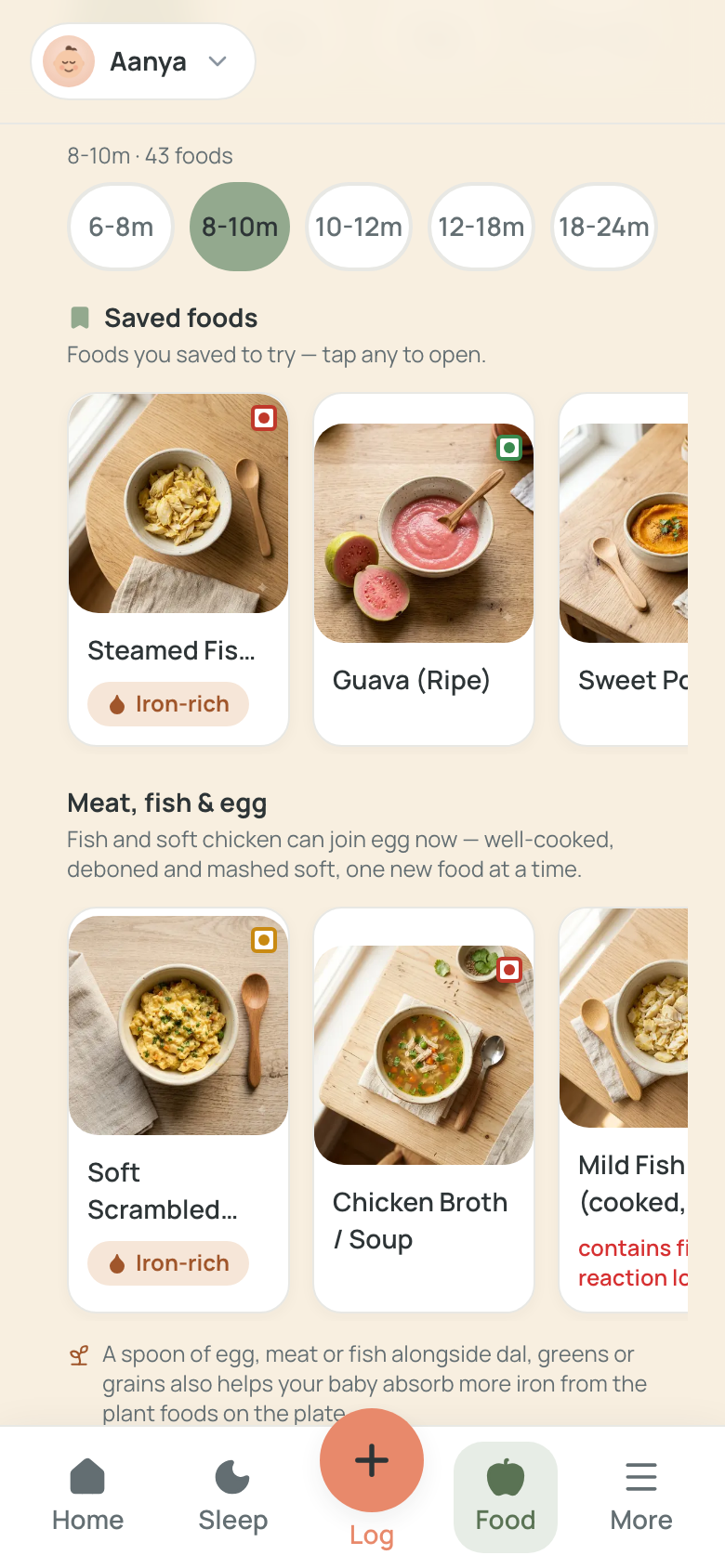
Saved foods
Spotted a food weeks before your baby can eat it? Bookmark it and it waits in a Saved row at the top of the guide until they are ready.
Bookmark any food from its detail sheet and it lands in a “Saved foods” row at the top of the guide, a persistent shortlist that carries across stages and sessions. A food you spotted weeks early is one tap away when your baby reaches it.
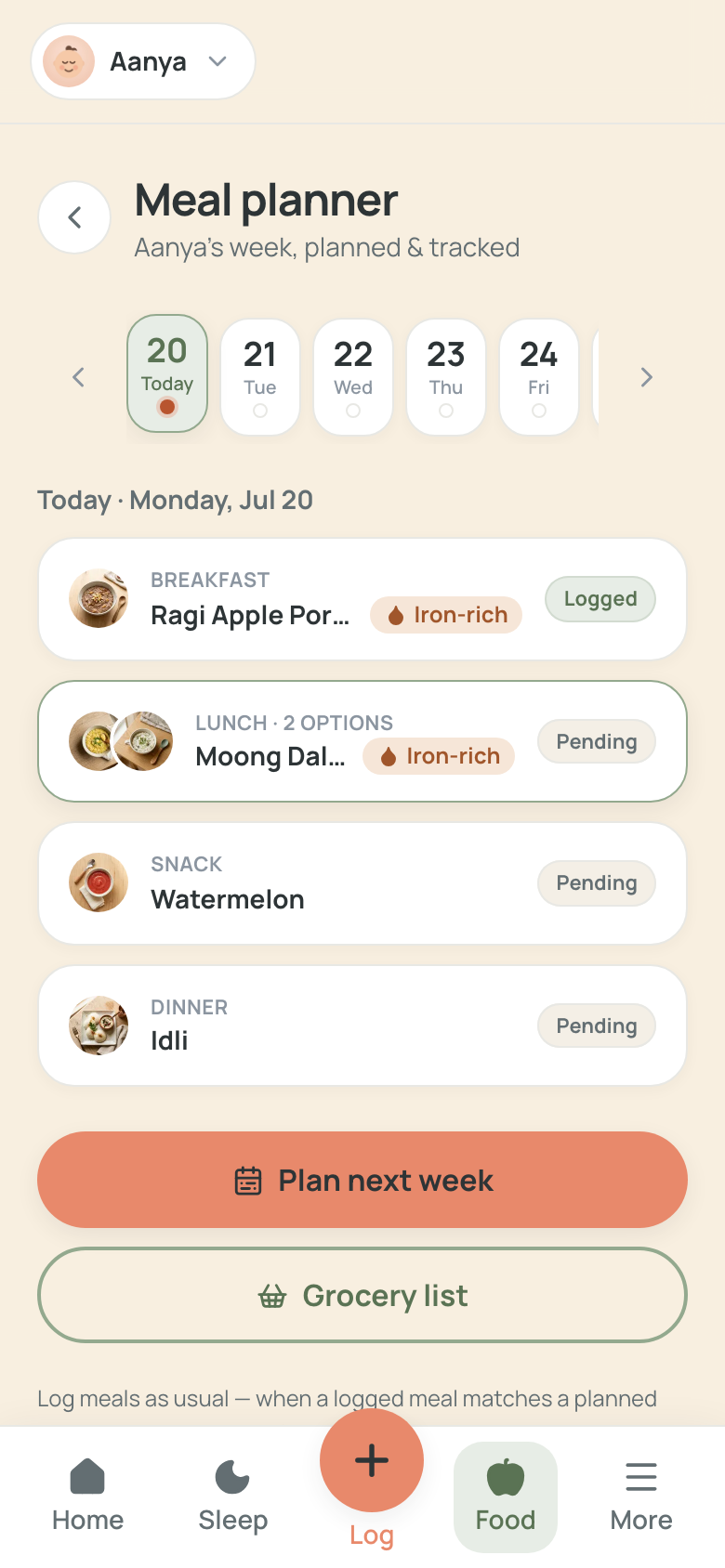
The weekly meal planner
Plan the week’s meals in one Sunday sitting, and munmun ticks each slot off by itself as you log meals, then writes the shopping list for you.
Four slots a day (breakfast, lunch, snack, dinner) for any food in the catalog or your own home dish, each shown with its food photo. A slot can hold several options at once (“khichdi or curd rice, whichever gets cooked”), what-to-try-next suggestions fill the blanks, and a good week copies forward in one tap, landing a count-named “12 meals copied to next week” so the big batch gets its due. Iron-rich picks carry their rust chip, so the plan itself nudges the nutrient that matters most. Every slot save or clear names what changed (“Lunch planned”), and filling the last empty slot swaps that for a small “all planned” note confirming the day is done: a finish line for the four-slot goal, with no streak to keep alive.
No second log to keep. When a meal you log matches any of a slot’s planned foods in its time window (breakfast 5–11am, lunch 11am–3pm, snack 3–6pm, dinner from 6pm), the slot flips to Logged on its own, and each day’s dot turns sage (followed) or coral (partly). A late dinner logged after midnight still counts for the day before, and a manual Followed/Skipped override always wins.
The week’s plan becomes what you’d actually buy: khichdi lands as rice, moong dal and ghee, and ingredients shared across dishes merge into one line. Tick items off as you shop (ticks are remembered per week), and staples the plan doesn’t know, like curry leaves or biscuits, are one tap to add.
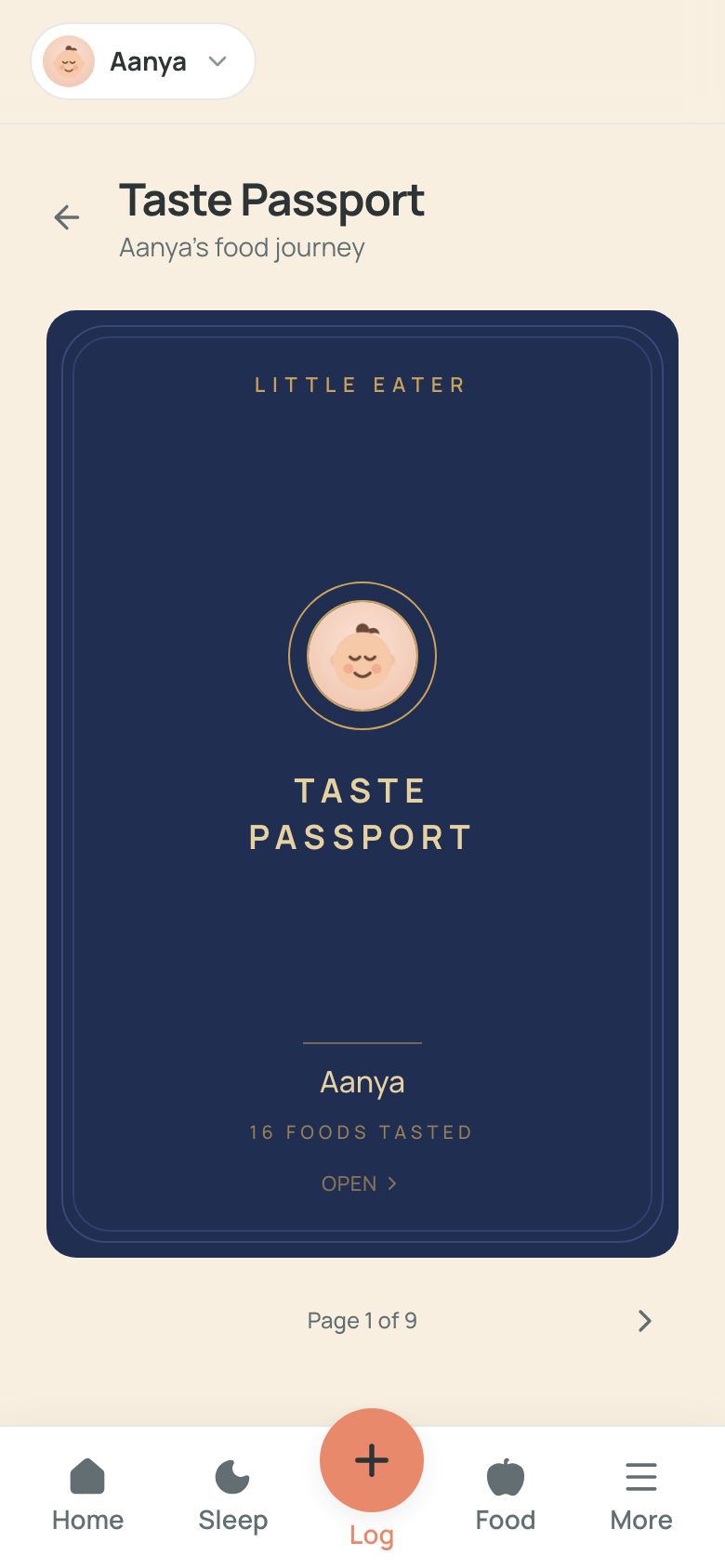
The Taste Passport
Every food your baby has ever tasted becomes a keepsake: an actual passport booklet you page through, built entirely from the meals you already log. Nothing new to track; the stamps simply appear.
The food page's job is what-to-feed, so the passport sits as a compact tile in one glance row with the Planner and the Travel pack. It leads with a tiny passport photo, your baby's picture in the cover's gold ring, above the foods-tasted tally, and opens the full booklet full-screen, so it never crowds out the food guide. Memories still carries the fuller keepsake card with the mini navy cover and a fan of stamps.
A navy, gold-foiled cover with the baby’s own photo set in the crest. Tap it to open and page through, cover to stamps; it looks the same in light or dark, like a passport you hold.
A passport bio page: the baby’s photo, a passport number, nationality “Little Eater”, foods and groups tasted, an issue date, and a headline rank, the strongest palate title they’ve earned. Titles line up as endorsements, with the next one shown as a faint locked stamp. Right beneath it sits a short “3 more foods to go” line over a thin fill bar, so the next honour always looks close enough to reach.
Each food is stamped onto the pages: an inked, hand-tilted frame around its photo with the date first tasted as a postmark, grouped one food group per page, and named in your family’s own food language. Notable firsts and the Annaprashan ceremony get their own red-ink page.
Tap a stamp to open it and make it your own: jot a one-line memory (“made a hilarious face”) and add a photo. The photo even borrows itself: it auto-adopts the most recent meal photo you already logged for that food, so many stamps arrive with a real picture for free, and you can swap in your own. An enriched stamp wears a tiny camera or ink dot so it stands out, and everything is opt-in per stamp and editable in place.
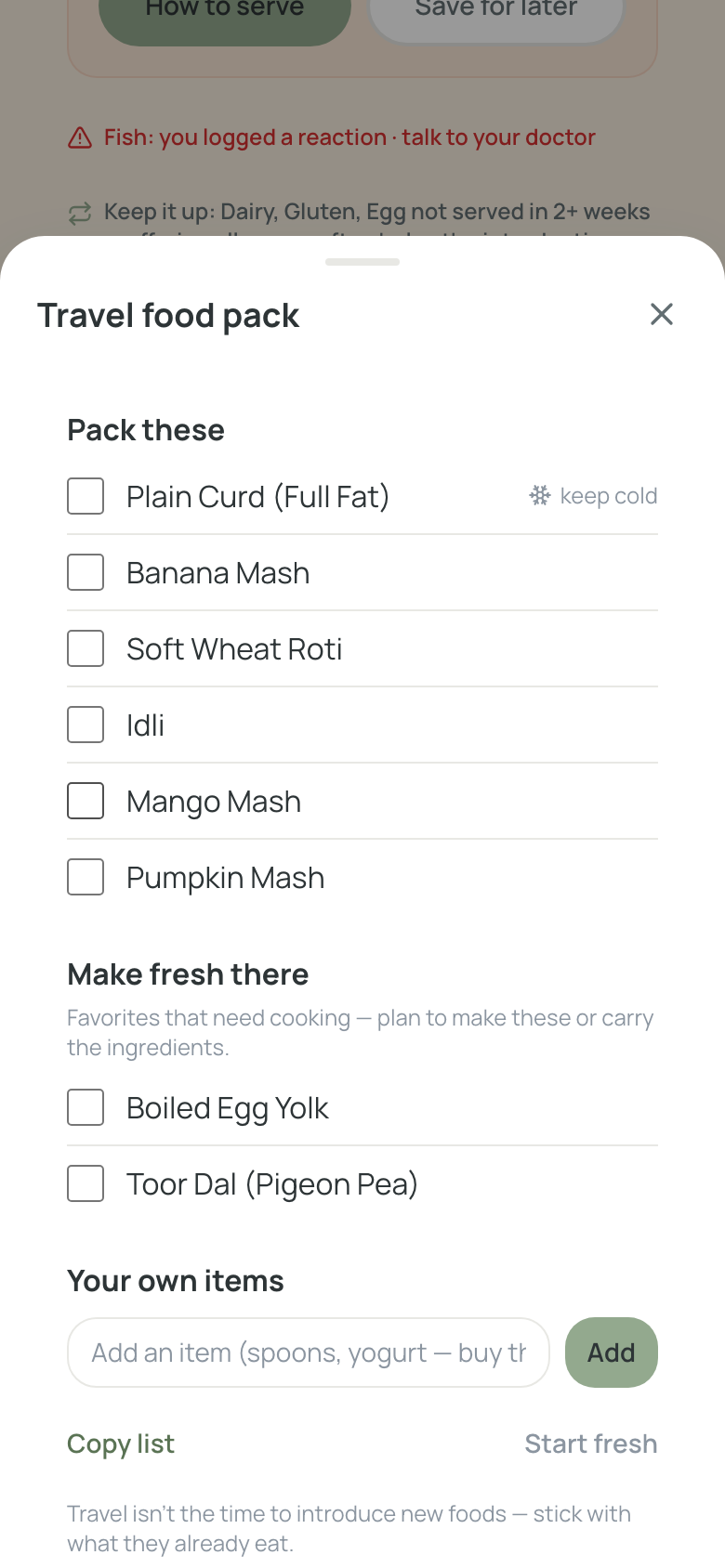
Travel food pack
Heading off on a trip? munmun reads the foods your baby actually finishes and turns them into a packing list: the safe bets for the road, split by which ones travel as-is and which are worth cooking fresh when you arrive.
On a trip a baby reliably eats the food they already know: their proven favourites, while a new store-bought purée tends to get refused. So munmun looks back over the meals you’ve logged, picks the foods your baby actually finishes, skipping the merely tried, and lays them out as a packing list. It splits them in two. “Pack these” holds fruits and ready foods that travel as-is, with a gentle “keep cold” note on things like yogurt; “Make fresh there” holds rice, dal and porridges you can’t carry ready-made, so you plan to cook them or pack the ingredients. Every food is a tick-off box: check each as it goes in the bag, add your own lines (spoons, a bib, “buy yogurt there”), and “Start fresh” wipes the list for the next trip. A baby with only a handful of meals logged still gets a list; it fills in with foods that are looking promising, so the card always has something to offer. One quiet line sits at the foot: travel is a time to stick with the foods they already love, and save new introductions for home. There are no trip dates or reminders, just a single always-ready list you open whenever you’re packing.